Wednesday, January 9, 2013

Camera upgrade - selected Sony NEX 5N - results Part 1

Some past posts were about what camera we should use for our upcoming green screen experimental feature.  Made selection, done deal, I went for a Sony NEX 5N
This was on a special reduced price here in New Zealand.
I am guessing that had something to do with newer NEX models coming out.
The reviews suggest that this model 5N does video better than the newer ones.
I had some concerns at the need to buy a 50fps  PAL model.  I did consider trying to buy a secondhand 60fps NTSC example from EBAY.  Some web searching indicated that most target film festivals can handle 50fps or the obvious 25fps derivative video.  NTSC conversion is do-able for us based on experience with our short film "Laputa" as described elsewhere in this blog.  
[Aside note - I suggest that this whole 2 alternative model thing that camera manufacturers do has become obsolete and they should sell us NTSC everywhere for consumer and semi-pro cameras.  Most computers systems are effectively NTSC and all modern TVs and Projectors can do both.  The flourescent light flicker rate issue is easily fixed with shutter speeds of 100, 50 or 25.]

Some first results and impressions.

Green Screen
YES - best results I have ever seen from our testing, which is a relief after buying this camera based on reports from others.  Test here is where the subject (me) is moving around a lot - story is riding in an SUV on a bumpy road - this is the test that has caused the most problems for other tested cameras.  This image is taken from the video in the middle of one of my highest speed action movements - leaning sideways.

Tech.  Kit lens manual settings with slight under-exposure. Shutter speed 1/100 sec.  Tungsten lighting.  Scene setting "Normal".  Video best setting 50fps and 28Mbps.

Moire problems?
NOT FOR US.  Some reviewers state that there are "moire" issues with the NEX 5N but we have seen nothing in 3 weeks so far of operation with a variety of tests and 1 production shoot so far.  But note that the way we film puts us at low risk of moire issues.

Use prime lens collection?
YES - this works well!  I have now bought a collection of lens adapters from EBAY store "jiakgong". 1980 vintage lenses from my Russian Zenit camera adapt just fine and working with them is straightforward.  I am about to start testing borrowed Nikon lenses.  Images following are an experiment in taking the zone-focussing capability to artistic extremes.

1. Kit Lens, moderate zone focussing ...

2. Russian Helios Lens f=58mm, aperture=f/8, shutter=1/100

3. Russian Helios Lens f=58mm, aperture=f/2, shutter=1/500 - ZONE TO THE MAX


Can NEX 5N make my 1953 vintage Bolex 16mm movie camera live again?
PARTLY - It is possible to adapt the 1953 C-Mount lenses to the NEX 5N but they cover an area just over 10mm wide in the centre of the 20mm wide sensor.  This area is about 2000 pixels across so in theory with a re-sampling digital zoom control the old 16mm lenses could ride again.  BUT the NEX-5N digital zoom switches off for video.  Therefore this lens collection can deliver reasonable stills, but for video the result needs to crop to about 800 x 450 pixels.  ie NEX 5N can party like it's 1953 but only in standard definition.  I read that new NEX models coming out starting with the NEX-EA50 will have a digital zoom that can resample.  This leads me to a cheeky comment about the "Digital Bolex" project to make a camera that is the "spiritual successor to the Bolex".  My opinion: guys you are too late - NEX has already got there and it looks like Panasonic is heading in this direction as well.

Thursday, December 27, 2012

Do Androids Dream of Electric Fences?

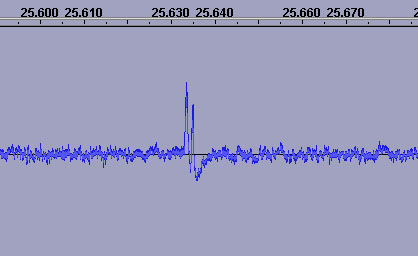
In my previous posts I have sung the praises of cellphones as portable sound recorders.  We have done some good trials with Android smart phones running the downloaded app "PCM Recorder" - until last week when recording in a farmhouse and getting a rhythmic "click" noise on recordings.

Our farmer hostess suggested "Electric Fence" and we confirmed that after some more tests including a test recording in the nearby town.

This cellphone is a  low-cost Vodafone 858 made by Huawai.  In other tests it has done well in electrically noisy environments which have given trouble to other devices but we now discover that it is vulnerable to electric fences and we will need to be alert about other interference possibilities.

We were filming piano performances with a Sony NEX 5N camera.  Fortunately the on-camera mics did a good enough job, without clicks, but needing a little hiss removal in post.

In images below I have zoomed in on the y-axis to enlarge clicks which have a peak height of -36 dB.


Wednesday, November 21, 2012

Laputa online at Youtube

"Laputa" Version 2. A completed version at last. Began as a wildly and wonderfully over-ambitious entry in the NZ "V" 48 Hours competition in May 2011. Over 1 year later the animation, fx, green-screen, audio, editing is done and the festival- only period is over, so hello Youtubers!.
http://www.youtube.com/watch?v=9hw9MoOLqUs

Saturday, November 17, 2012

Our next movie - what camera to use - Part 2

Part 1 is down 3 posts from this one, or if you are seeing posts separately then the direct link is:
http://iafilm.blogspot.co.nz/2012/10/our-next-movie-what-camera-to-use.html

In brief, we think it is now possible to shoot an experimental no-budget feature in a borrowed classroom with a green screen setup.  The big enabler is the improvements in video editing software, eg the "Keylight" compositing plugin in "Adobe After Effects".  Sharing some thoughts from further reading, asking questions and running some more tests.

We have run tests with borrowed Canon HV20, Canon HF R20 and Sanyo VPC-HD2000.  This opened a whole new issue in that we discover we like the 60p (60 full frames per second) high frame rate of the Sanyo.  So now we gotta go 60p, or maybe 50p because we are in PAL territory New Zealand.  Further details.

Sanyo VPC-HD2000 - We were able to test this briefly.  We kept it simple and set it to preset "sports" following advice that a high shutter speed is a good idea.  Clear winner for a clean key result including movement at 60p and we like the 60p look.  Colours were warm and over-saturated but if we had more time with this we could probably explore its settings and do better.  The Sanyo dates from 2009 and was a cutting-edge camera then.  We and other bloggers note that Panasonic have now bought Sanyo and 60p has since been appearing on Panasonic cameras so we are guessing that Panasonics with 60p are the children of this Sanyo and worth further investigation.

Canon HV20 - an "old" as in over 5 years old cam.  HD 1920 x 1080 on tape using MPEG-2.  The attraction was that this has more manual control than the other cams we have access to.  We ran this at 25p.  Very good keying results until we do subject movement then we do not like what happens.  Staccato quality of movement and on reversing direction subject heads seem to have a ghost image that shows up by lagging a little behind the main image.  We ran trials at shutter speeds of 1/50sec and 1/250sec following some theory that 1/250 would be good but we can see no significant difference.  Our all-green-screen short film "Laputa" shot with an HV20 is now online at:
http://www.youtube.com/watch?v=9hw9MoOLqUs

Canon HF R20 - amazingly good camera for its low price of USD 280.  We tried 24p, 30p and 60i frame rates.  30p was best with 24p a close second - both were good for keying but some of our viewers did not like the subject movement especially motion blur on human subjects.  Best keying with "cine" setting.  Could be used for a green screen epic which is low on subject movement - and that may be the case with our possible literature-based drama.

What others are saying about green screen work - with my personal comments

"Compression is bad - you need very high bit rate technology" - eg Blackmagic HDMI capture, Panasonic GH3.  I disagree on this and I suggest that the AVCHD-2 standard of 60p at 28 Mbps is a viable, low cost accessible way to go. 
Argument from theory - AVCHD temporal compression works by recycling non-moving background elements and is going to work at its best efficiency with a simple background ie a green screen. 
Argument from experiment - with the Canon HF R20 we have done trials at bit rates of 5Mbps and 24Mbps and 5Mbps looks remarkably good and not much different to 24 Mbps.

"Cine setting is good" - Agree

"Use 'hard colour' setting in Keylight rather than the default 'soft colour' setting" - Agree, has made a good improvement to our trials and also in re-working some older shorts.  Thanks to the Dastoli Brothers website for this advice.

So the continuing question of what camera?

Top of the desirable list is the soon to be released Panasonic GH3.  Testing website www.digitalcamerainfo.com names this in their 2012 awards article as the best system camera for video.  Too expensive for us and we will need to go more modest for our quickie experimental feature.  Top priorities for our spending are likely to be food and transportation.   Maybe we can find someone who has bought this or similar to join the co-op as guest camera operator even for some of the shooting?  We have done this kind of thing before! 

Candidates are 1080p60 capable cameras and we would like to go digital large sensor lens-interchangable.  Some models we are investigating are:

Panasonic G5 - Some impressive sample videos on Youtube but conflicting opinions expressed on the web about possible limitation of manual control of settings for video.  Trying to find out more.

Sony NEX-5N, Sony A-57 - Mostly good reviews but with some warnings about "moire" effect and I have seen this in sample videos on Youtube eg when tiled roofs get into shot.  Trying to find out more.  Maybe a green screen production is less likely to hit moire situations than shooting in the wider world?

Interesting Web links:

"Dastoli Digital - Simple Tricks and Nonsense"
http://www.youtube.com/playlist?list=PL2B20D1B93B68C825


"Sony NEX-5R vs Panasonic G5: Four Reasons to Buy the Sony NEX-5R OVER the Panasonic G5"
http://www.youtube.com/watch?v=X6fLAxbbEIg


Sony Alpha NEX-5N Review with lab testing including video capabilities testing.
http://www.digitalcamerainfo.com/content/Sony-NEX-5N-Digital-Camera-Review.htm


Sunday, November 4, 2012

Example of no-budget movie success - but what is success?


http://news.bbc.co.uk/2/hi/entertainment/8171678.stm

News report about Marc Price who has had a no-budget success with a zombie movie.  Good advice on how to make a no-budget movie - quality of acting performance matters more than the camera.  Questions - is this yet another zombie movie or are there elements of originality or allegorical themes to this?  Anyone know of recognition for no-budget movies with in depth themes like social justice?  I am aiming to start a no-budget movie project going with risk-taking originality - and to me it is essential to do that to make the time worthwhile.

Saturday, October 20, 2012

Recommended: "Michael Goi ASC, Shooting TV with the Sony F65"

"Michael Goi ASC, Shooting TV with the Sony F65"
http://magazine.creativecow.net/article/michael-goi-asc-shooting-tv-with-the-sony-f65

This is a specialist tech article from a top expert, but this is also remarkably readable for creative indies, students and beginners with some relevant advice eg "We didn't work in the raw format because TV post production can't deal with the enormous file sizes we typically use on features." - good to see that his world is not so different to ours! Also good to read what tech aspects are priorities for Michael eg "LUT", "Waveform" so we can follow up as to what they about - and can we engage with them at our level?

Saturday, October 13, 2012

Our next movie - what camera to use? - Part 1

We (IAFilm collective) have been on our current wave of making digital shorts since 2002 and with persistence has come improvement and some film festival screenings this year (2012). Next step is to take on the challenge of a no-budget feature. Possible shape is a drama with elements of fantasy taking on themes of "the gap between rich and poor" and "climate change". All shot human actors + greenscreen with digital-artwork backgrounds. Tech experiment of using readily available equipment to explore and push the democratisation of film-making. Use of smartphones as double-system audio recorders means that for cameras, we only need to worry about "bang for the buck" video capability. Interesting thought exercise as to what camera to use.

IMO useful internet sources from my searching:

"Making the Movie" - blog led by indie film-maker John Ott. Article on cameras at:
http://makingthemovie.info/2005/03/hd-camera-comparison.html

DXOMark. Independent lab testing of camera sensors. "Landscape" dynamic range test is the one of most interest to me:
www.dxomark.com


Leading to my current list: from most expensive possibilities .. to reality of what we can borrow now ... Very approx values in USD

Blackmagic Cinema Camera, USD 3000
Custom sensor and body writes uncompressed or low-compression video to a built-in SSD drive. Takes Canon EOS lenses. Looks like very high quality for serious indies at a reasonable price. Reviewed in detail by indie film-maker Marco Solorio. Impressive results in his dynamic range test and green screen test.
http://vimeo.com/49875510


Panasonic X900, USD 1200
Top of line consumer video camera with "3-MOS" sensor. Excellent resolution results in this test:
http://www.camcorderinfo.com/content/Panasonic-HC-X900-Camcorder-Review.htm


Canon HF G10, USD 1500
Top of line consumer video camera. Interesting recent development from Canon as they change their video sensors from 10 Megapixels to 3 Megapixels in order to concentrate on doing video well without trying to do double-duty as still cameras.
http://www.camcorderinfo.com/content/Canon-Vixia-HF-G10-Camcorder-Review.htm


Canon "entry level" HD video cameras: eg HF R20, HF R30, HF R300, HF M40, USD 300 - 600
Also making the move to video-oriented sensors like the top-line models.  We borrowed an R20 for our 2012 "V 48 hours" movie -  worked well - includes green screen shots - view here:
http://www.youtube.com/watch?v=aTzZ6_S-1mA
Impression of our results so far is "almost good enough" but in the "V 48 Hours" competition we used lower-quality settings to achieve faster post-production. More testing todo including the options for 24fps, 24Mbps and "cine mode".


Panasonic Lumix FZ200, USD 700
This is a stills camera which can also do video. In theory at a disadvantage because of 12 Megapixels as small pixels on a chip about the size of a little fingertip. But the small chip leads to some lens design advantages as a trade-off.  Attractive on the democratisation principle as a popular hybrid camera that promises to do lots of jobs well. Gets good reviews. Can record 1080p60 at 28Mbps (which is good). DXOMark testing of its predecessor, FZ150, reveals that it can almost match the big-chip DSLRs for dynamic range at 100 ISO but it falls behind as the ISO goes up. Translation - needs good lighting. Owner "popi" writing in a "dpreview.com" forum reports owning both and observing FZ200 sensor improvement. Wins points from John Ott ("Making the Movie" link above) reporting success in shooting a quickie feature movie with one of the earlier Panasonic Lumix LX3 cameras. 
Example FZ200 review with sample video direct off the camera:
http://www.photographyblog.com/reviews/panasonic_lumix_dmc_fz200_review/sample_images/


Canon EOS EF DSLR entry-level-plus series eg EOS 550D, EOS 600D, EOS 650D, T3i "Rebel", USD 800
Current darling of many indie film-makers for some extended creative control possibilities. The big sensors give good dynamic range and good low-light capability. But camcorderinfo.com gets test results where they deliver less line resolution than cameras focussing on video like the Canon HF G10 and Panasonic X900. " ... 650 ... a pretty good score for a video-capable DSLR, though it certainly doesn’t come close to what we’ve seen from higher-end video-oriented cameras ..." . That may be important for a green screen production. On my todo list is to rent one of these for a weekend and run my own green screen tests.


Olympus V310 pocket stills camera with video, USD 180
Like almost any stills camera, has an HD Movie setting. Moderate HD setting of 720p30 but interesting in its use of the simple MJPEG codec which means it records a complete image for each frame. This gives it an advantage for shots with motion. The only other camera on this list that can do that is the Blackmagic at USD 3000. V310 also delivers a high bandwidth of 33Mbps which is great for indies. Early testing comparing with the V310 indicates good sharpness, but possible issues with low light capability, dynamic range and high colour saturation. TODO more testing trying different menu options. Looks at the least like a useful special purpose and experiments camera. Review of the similar VR320 at:
http://www.digitalcamerainfo.com/content/Olympus-VR-320-First-Impressions-Review.htm
In the comments, "hammerogod" says this "...MUCH better Video than I expected...MUCH better.It should be advertised as a Video cam that takes Stills ..." so I am not the only one who has noticed.